
Oakland Busted Mugshots Explained
Two agencies split the work here. Oakland Police handle city enforcement, while the Alameda County Sheriff's Office runs detention for the whole county. The split shapes every search. OPD writes the incident and arrest record; if county custody takes the person, Santa Rita Jail creates the booking entry and takes the identification photos. A citation and release can skip Santa Rita entirely. Arrests by other agencies inside Oakland may never touch the OPD log either.
The city counted an estimated 443,554 residents on July 1, 2024, per Census QuickFacts for Oakland. That makes it the largest city in Alameda County and the county seat too. Its size is why Oakland keeps the most detailed municipal police log of the three cities covered here. But the log is not a face index. It lists police activity across a stated stretch of days; the county locator is the tool that answers who is actually in custody right now.
Oakland Daily Arrest Log
The official OPD Daily Log publishes PDF files that usually span about one day. The files describe incidents, arrests, and other police work. Month and year archives make the log useful when a search starts with an event date rather than a name. Its date window is more precise than Fremont's or Hayward's weekly summaries, which is the city-page distinction identified in the Alameda research.
The capture below comes from the Oakland Police Department Daily Log source, not a rehosted booking photograph or person-level result.
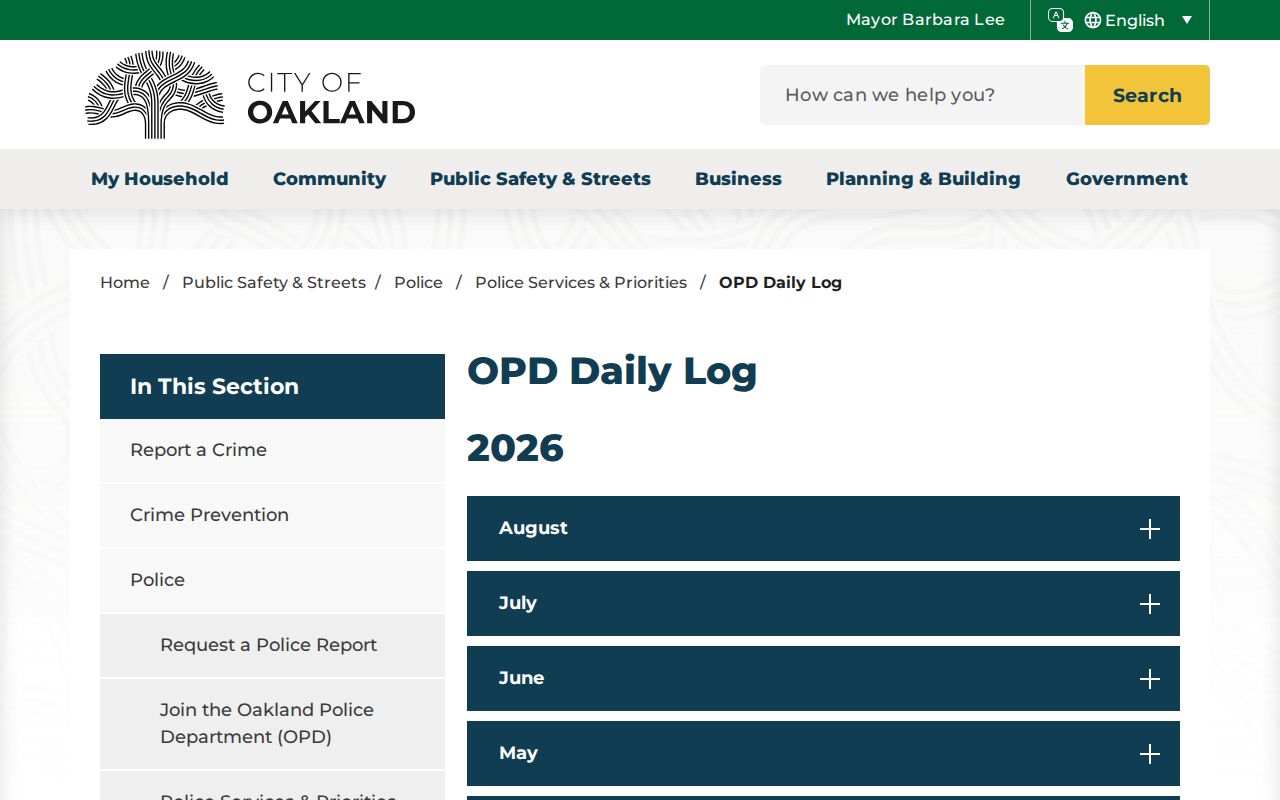
The archive can establish OPD event context and a likely time window. It cannot confirm present custody, show every arrest in Oakland, or establish that a listed charge was filed in court.
Daily log timing and jail timing do not always match. An OPD event can end in cite and release. County intake may occur after the PDF's period closes, or another agency may make the arrest. Exemptions and open investigations can also limit what appears. For those reasons, a missing name in one source is a prompt to check the next official source, not proof that no arrest occurred.
Note: Treat each OPD PDF as a police-stage chronology, not a complete list of Oakland bookings or a custody census.
Where Oakland Busted Mugshots Appear
Start any Oakland booking-photo search with official records. Each channel maps to a different stage of custody. A targeted records request is the only verified path to a booking image. News sites and commercial archives belong at the end of the list, since it is often unclear how they picked their images, when they posted them, or where the pictures came from.
| Channel | Record or photo | Coverage | Status |
|---|---|---|---|
| OPD Daily Log | Police event details; photos are not routine | Roughly daily Oakland police activity | Official |
| ACSO Inmate Locator | Identity and custody status; no public photo verified | People accepted into current county custody | Official |
| ACSO NextRequest | Specific booking record and requested intake photo | Releasable current, released, or older sheriff records | Official request route |
| Superior Court portal | Filed case and later court events; not a photo source | Public criminal cases subject to access limits | Official |
| RecentlyBooked Alameda | Selected cards and images of uncertain completeness | Claims rolling county coverage that includes Oakland | Unofficial and may be stale |
| Mugshots.com Alameda archive | Older copied entries | Historical material, much of it from earlier years | Unofficial and not a current feed |
RecentlyBooked sends mixed signals about whether Alameda County even provides photos. A face on that site proves little about its origin. The older archive is weaker still for tracking current custody. Treat both as leads at best. OPD, the Alameda County Sheriff's Office, and the court remain the sources that count.
Finding Who Got Busted in Oakland
A solid Oakland lookup traces the paper trail from the street to the jail and finally to the courtroom. Those steps rarely land on the same day. Start with what you know. That may be a full name, the date of the incident, or a police report number. From there, ask each system only the question it can answer.
- Open the OPD Daily Log for the date range. Use it to confirm police activity and gather an incident or report reference when one is published.
- Search the ACSO locator by PFN if known. Otherwise use first and last name, with middle name, date of birth, sex, or phonetic search to narrow the result. Wildcards do not work.
- If the locator has no result, account for cite and release, intake timing, a spelling mismatch, release before the search, transfer, or a record withheld by law. Contact OPD Records for the police record.
- For a Santa Rita intake image or a released person's booking record, submit a narrow ACSO request naming the person, date, arresting agency, PFN or booking number, and desired electronic format.
- After a complaint is filed, check Alameda Superior Court by party name or case number. The court disposition, meaning the final recorded outcome, is more reliable than an intake charge.
For the county-wide picture, the Alameda County busted mugshots search walks through the broader roster and records process. Someone sentenced to state prison shows up elsewhere. The CDCR's own CIRIS system holds those inmates, not the Santa Rita custody list. Federal and immigration custody each run through their own locators too.
Note: Save the PFN when available because it helps distinguish similar names and can support later Alameda court hearing searches.
Oakland Arrest Records Requests
The Oakland police-report request page takes requests online, by mail, or at the Records Division counter. Ask OPD for the incident or arrest report it wrote. A Santa Rita booking record or front-view intake photo may get routed to ACSO. The Sheriff holds the county jail file.
Give the office what it needs to find one event. That means a full name, any aliases, the event date, the report number, and the exact record you want. OPD promises a determination on non-urgent requests within ten days. That clock covers the decision, not the delivery. Release can still hinge on open investigations, privacy rules, exemptions, redaction, and whether the office holds the file at all.
OPD Public Records Request Unit
455 7th Street, Room 306
Oakland, CA 94607
Public-records phone: (510) 238-7143
Email: opdrecordrequest@oaklandca.gov
Room 306 counter: weekdays, 8 a.m. to 3 p.m.
First-floor kiosk: weekdays, 8 a.m. to 3 p.m.; weekends, 8 a.m. to noon.
What does a copy cost? Oakland's own pages disagree. One shows paper records as free. A different form quotes five cents a page. A disk with audio or video runs $5, and a custom electronic compilation could cost more. The safest move is to call OPD, ask for the current fee schedule, and get a written estimate before work starts. No one has confirmed a separate price for booking photos from OPD or the Sheriff's Office.
Oakland Booking Route to Santa Rita
Here is the pattern that shows up again and again in Oakland. An OPD arrest comes first. Custody at Santa Rita may follow. A court case comes last, and only if prosecutors file charges. Not every arrest walks the full path. Some people are cited and released on the spot. Others never reach county custody because of medical care, juvenile handling, a transfer, or some other lawful step that interrupts the sequence.
- Arrest log
- An agency account of police activity during a time window. It does not prove jail admission.
- Booking
- The jail intake process that creates identity, charge, property, custody, and photograph records after acceptance.
- PFN
- A person file number used in Alameda custody and some court search tools to distinguish records.
- Disposition
- The court-recorded result of a filed case, which may differ from the charge listed at arrest or intake.
Need to know who is in custody right now? Start with the Sheriff locator. The agency calls it real time. Booking photos do not appear on the public side, though. Detailed views also switch off once a person walks out, so think of the tool as a live window rather than a lasting archive. Already released, or chasing an image? The ACSO records portal is the official fallback. One more wrinkle exists. A "Pending Release" label only means processing has started. A separate hold can still keep the person in jail.
Oakland Busted Coverage Limits
Oakland's Daily Log archive runs deep. That depth is its strength. Its weakness is scope. The log tracks events by time, not every body held at Santa Rita, and years of archives do not magically turn it into a booking-photo collection. OPD news releases are even more selective. A release might carry a scene photo or an evidence image, yet plenty of logged arrests never earn a single headline.
The Oaklandside Public Safety desk covers Oakland policing, courts, violence, and emergency response, while the East Bay Times Crime and Public Safety section adds broad regional reporting. Both are news outlets, not arrest feeds. What they choose to cover, and which images they run, follows editorial judgment rather than any system. Neither can confirm current custody or how a case ends. To compare city logs and news coverage side by side, visit Alameda County Arrest News.
Commercial pages operate differently. They may keep copies of images long after the official display changes or a person leaves jail. Their numbers can clash wildly, and a city label on one page may not reflect where the picture actually came from. Treat these pages as leads only. Verify the event with OPD, custody with ACSO, and the outcome with the Alameda Superior Court.
Note: No verified Alameda-local section exists for BustedNewspaper, Arrests.org, or Mugshots.zone, so guessed county links should be avoided.
Oakland Arrests Reach Court
A booking charge is a snapshot of one moment. It reflects only what the arresting agency wrote down at intake. It is not the prosecutor's complaint, and it is not a judgment. For the real case record, search the Alameda Superior Court Odyssey portal by party name or case number, within whatever access limits apply. The Search Hearings tool also accepts a case number, date range, CEN, PFN, or name. Confidential and restricted files stay hidden.
Oakland criminal matters usually land at the René C. Davidson Courthouse or the Wiley W. Manuel Courthouse, though hearing locations can shift. A Daily Log entry with no court match can mean several things: prosecutors never filed, the search data differs, or access is limited. That gap alone proves nothing about how the matter ended. When the portal falls short, the court's criminal-record request process is the way to get copies or certified documents.
Keep following the file through to disposition. Charges get amended, reduced, dismissed, or resolved in other ways after booking. That final check puts an Oakland arrest record in context, so an old photo never stands in as the last word.