
Alameda County Wanted List
The Alameda County Sheriff's Office Most Wanted page is a curated list with photos. Six people appeared on it when last viewed. Their warrant and photo dates run from 2002 to 2012. ACSO posts no update schedule. The agency also warns plainly that it does not guarantee the accuracy, timeliness, or reliability of what appears there. So verification matters. A photo might help you recognize someone the sheriff is seeking, but an old entry cannot tell you whether a warrant is still active. And a listing never gives anyone authority to approach, follow, detain, question, or threaten a person. It is not every active warrant in the county, either. Treat it as a starting point, nothing more.
Alameda Wanted Listing Fields
Each listing can mix identity data, warrant facts, a photograph, and an agency narrative. Fields vary from entry to entry. Match several identifiers, then let the agency confirm the current status.
| Field | What ACSO may publish |
|---|---|
| Identity | Name, alias, date and place of birth, race or ethnicity, and gender. |
| Description | Height, weight, build, hair, eyes, and a dated photograph. |
| Warrant reference | Warrant or report number, issue date, bail, and cited Penal Code section. |
| Charge | The alleged offense and an attributed investigative narrative. |
| Caution and contact | Warnings, assigned detective information, and the official tip route. |
People change their looks. Names and aliases collide. A photo alone is a weak match. A warrant number, a report number, and a current confirmation from Warrants and Records carry far more weight. Let the court record settle any charge.
Use Alameda Wanted Listings Safely
The photographs and full warnings stay with their official source. Nothing is copied here. Read the agency record in context, and keep recognition separate from status verification.
- Open the ACSO Most Wanted page and confirm that the listing remains visible on the official domain.
- Compare more than a face. Review the name, alias, physical description, report or warrant number, and photo date.
- Do not make contact or investigate. Move to a safe place if the situation feels immediate.
- Use 911 for an active emergency, dispatch for an urgent non-emergency, or the anonymous tip route for information that is not time-sensitive.
- Let law enforcement verify identity and warrant status. Do not publish an unconfirmed charge about a look-alike.
- After a reported capture, use the Alameda County booking and court path to distinguish custody from case outcome.
A roster result after capture is still just a booking and custody record. The booked charge may differ from the warrant narrative. Both can shift once a prosecutor reviews the case.
Alameda Anonymous Tip Routes
ACSO offers an anonymous tip line and a web form. The form states that submissions are confidential and not tracked or traced. An email is optional. One caution: it is not monitored around the clock. No reward was promised anywhere, so do not frame a tip as a paid submission.
Alameda County Sheriff’s OfficeAnonymous tip line: (510) 667-3622
Dispatch: (510) 667-7721
Emergency: 911
Official anonymous tip form
Stick to facts when you tip. When and where the person was seen, which way they went, and a vehicle description if you could safely note one. Do not trespass or trail anyone. Do not hunt for extra evidence. And never delay an emergency call just to finish the web form.
Alameda Warrant Status Check
Alameda County has no verified public countywide name-search warrant portal. The credentialed CRIMS eProcess page is restricted. Do not treat it as public. For an official check, use Warrants and Records, plus the Alameda Superior Court public portal when a criminal case exists. Keep perspective: the six-person photo list is far narrower than the county's possible active warrants.
- Call ACSO Warrants and Records at (510) 667-3685 with the person’s identifying details and any known case or warrant number.
- Search Alameda Superior Court Odyssey by party name or case number for a filed criminal matter.
- Use the court hearing tools for current dates, while recognizing that a short calendar search is not a full case history.
- If records remain unclear, submit a narrow ACSO public-records request for releasable warrant information.
- A person concerned about their own warrant should contact a lawyer or the court to arrange a lawful resolution.
A missing website result proves nothing. A record may be sealed or withheld. It may not yet be filed into the court system, or it may sit in a channel no public name search can reach.
Alameda Warrant Record Differences
A full local taxonomy is not supported here, but two practical categories help route the official check. Only the issuing court and the responsible agency can confirm whether a warrant remains active and what steps apply.
| Record | Meaning for a check | Safe response |
|---|---|---|
| Arrest warrant | A judicial command tied to an alleged offense or filed matter. | Verify through the court and ACSO; the affected person contacts counsel or court. |
| Bench warrant | A court-issued warrant commonly tied to a missed or unresolved court requirement. | Confirm with the issuing court; arrange lawful resolution rather than avoiding contact. |
| Most Wanted entry | A selective public appeal that may contain an associated warrant. | Send information to ACSO and do not approach. |
A wanted page is a publication choice. A warrant is a legal status. The first may be old or selective. The second demands current verification from the agency or the court.
Alameda Warrant Records Requests
Warrants and Records sits at 2000 150th Avenue in San Leandro. Call (510) 667-3685. That unit is the official first contact when a web search cannot confirm a warrant's status. Give the full name, a date of birth if you know it, and any court case, report, or warrant number. Ask what releasable information the unit can confirm and which court issued the warrant.
If a phone call leaves the question open, try the ACSO NextRequest portal. Search prior released requests first, then describe the record narrowly. California's public-records determination period is ordinarily ten calendar days, with a possible extension for unusual circumstances. That is no promise an active investigative record will be produced, since safety, investigation, sealing, and other lawful limits may apply.
A court file and a sheriff record serve different roles. The Sheriff can address the warrant it holds or serves. Alameda Superior Court can show the filed case, hearing activity, and later orders. Use both when the same identity or number shows up in both systems, and save the response rather than trusting a screenshot from an old wanted page.
Alameda Wanted Cases in Court
Once deputies pick up someone on the list, the paperwork shifts hands. Booking comes first. Then a prosecutor reviews the file and decides what to file in court. To track what happens next, the official Criminal Docket Finder interface lets you search upcoming appearances by docket number, party name, court record, or police report and agency. Juvenile records are left out. The tool is not a final-outcome archive.
Party name or case number works well in Odyssey Smart Search if you want the fuller court view. Some documents stay confidential or restricted even in public access. The charge listed at jail may not match what the complaint ends up saying. The docket fills in the rest. Hearings, rulings, and the final result all appear there as the case moves along.
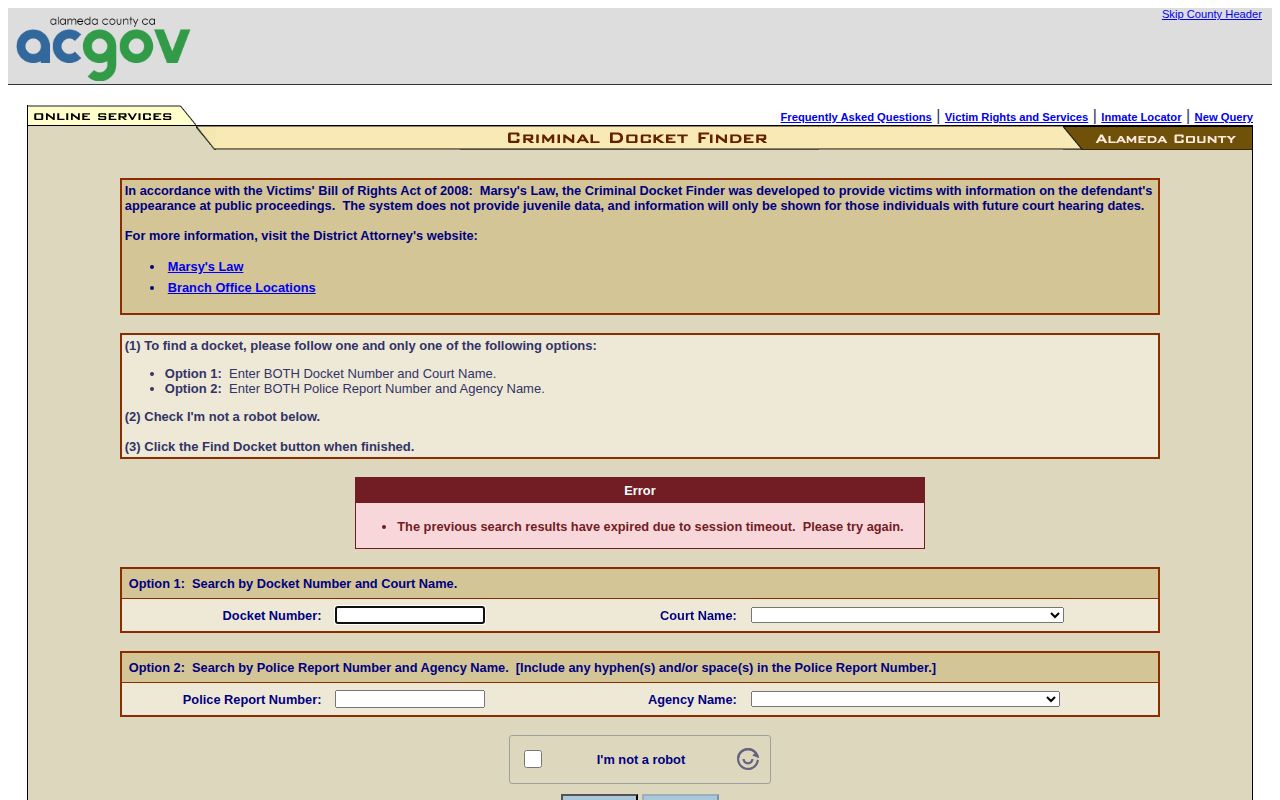
One limit on the docket tool is worth knowing. It shows upcoming court appearances, and it does not account for every active warrant in the county.
Alameda Arrest After a Warrant
An arrest on a wanted entry can happen anywhere. The listing says nothing about where the person lands. If Alameda County takes custody, the ACSO Inmate Locator may show a PFN and current status. Other routes exist too. A different jurisdiction, a federal agency, a hospital hold, or a transfer can all send the person elsewhere, so an empty roster never settles whether the warrant is still live.
County booking starts a record of its own. It lists the custody facts known at intake. A prosecutor then files whatever complaint fits the case. From there, bail amounts, holds, hearing dates, and release status can all shift. For the filed case and its result, the Alameda Superior Court record is the source that counts. The booking entry is simply the earlier event.
Be careful with the “Pending Release” flag. ACSO warns that release can take several hours, and a separate hold can halt it at any point. Treat that label as a hint, not a fact. The Sheriff can confirm current custody. The court docket carries the case events that follow.
Verify Older Alameda Wanted Entries
Old dates show up on the ACSO wanted list. Warrant dates and photo dates can sit there for years, with no fixed schedule for refreshing the page. Age alone does not make an entry wrong. It just means the date belongs in your verification step. Put it right alongside the official page's own disclaimer and a call to the unit that holds the warrant.
Social media fills some of the gap. Sheriff subscription alerts and agency accounts post selected cases. No “Warrant Wednesday” program or custody-search app exists in verified form, though. Posts have a way of vanishing while warrants stay active, or living on after a status changes. When social chatter and official channels disagree, the warrant confirmation and the court docket win.
Recheck the official listing whenever you pass information along. A dated photo, an alias, or a caution note helps ACSO evaluate a tip. None of it licenses private action. If someone's status looks different, give the unit the exact page and identifying number so staff can correct the source record. Skip the reposted screenshots. They routinely drop warnings, dates, and later fixes.